
 “I feel like my schedule isn’t as efficient as it could be. Some days everything runs smoothly, and other days it all falls apart. How do I keep a smooth, efficient schedule that holds up every day?”
Here’s the first thing to understand: there is no single, one-size-fits-all schedule template. Every dentist does a different kind of dentistry, and a different kind of dentistry demands a different mix of production, a different number of new patients, and a different amount of chair time. So a scheduling system that works perfectly for one practice can fall apart in another.
That said, there are a handful of basics that have to be in place no matter what kind of practice you run. Once those are represented on your schedule, the chaos starts to organize itself. Let’s walk through them.
Table of Contents
- Every Function You Perform Has to Live on the Schedule
- Template the Schedule Around Those Numbers
- When There Isn’t Enough Time in the Day
- Build In Time for the Day That Doesn’t Go to Plan
- How to Actually Handle Emergencies
- The Bottom Line
Every Function You Perform Has to Live on the Schedule
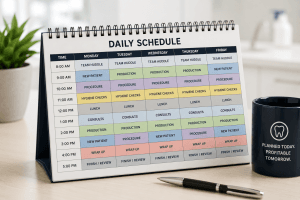
The core principle is simple: if a function matters to your practice, it needs to be represented on the schedule. The most common mistake is treating the schedule as a list of appointments instead of a blueprint for the whole day. Your production isn’t the only thing that needs a home on the calendar. Your sales time, your consults, and your new patients all need dedicated space too.
Start by mapping out these essentials:
- Production time. If your production quota is $5,000 a day, figure out how many hours of chair time that actually takes, and block it.
- Sales time. Time to present and close treatment. This also needs to include your hygiene checks, which quietly eat more of the day than people expect.
- Consults. How many consultations do you need on the schedule each day to keep treatment moving?
- New patients. How many new patients does your practice need each day to support the kind of dentistry you do?
- Start and finish time. This is the one people forget. You can start $5,000 of dentistry, but you also have to finish it. Your delivery start time and your finish time both have to be built in.
In short, make sure your start time, finish time, sales time, and new-patient time are all represented on the schedule, and that your hygiene checks are accounted for within that sales time.
Template the Schedule Around Those Numbers
Once you know how much you need to produce, how much production time that requires, how much sales time you need, and how many consults and new patients you’re aiming for, you can template the schedule around those numbers rather than filling it in reactively each morning.
This is also where you find out the truth about your day. When you add it all up, one of two things happens: either everything fits, or it doesn’t. If it fits, great. If it doesn’t (for example, there’s no room left for your hygiene checks), that’s not a scheduling failure. It’s information, and it points you toward a fix.
RELATED VIDEO: 🎥How to Fix an Unpredictable Dental Schedule
When There Isn’t Enough Time in the Day
There are only so many hours in a day. If you’ve templated the schedule and everything you need genuinely doesn’t fit, the answer isn’t to cram it tighter. It’s to change the structure. Work through these options in order:
- Add a second assistant. If you’re scheduling vertically, whether out of one operatory or two, and there still isn’t enough time in the day, it may be time to add a second assistant. Often the bottleneck isn’t chairs, it’s hands, and a second assistant can be the difference between a schedule that flows and one that constantly stalls.
- Bring on a part-time associate. If you already have two assistants and the day still doesn’t fit, it may be time to hand the smaller dentistry to a part-time associate. That clears your schedule for the higher-value work only you can do.
The point is this: if the work genuinely won’t fit no matter how you arrange it, the answer is a structural change, a second assistant or a part-time associate, not a more crowded schedule.
Build In Time for the Day That Doesn’t Go to Plan

Now for the part everyone asks about: how do you leave room for emergencies and the inevitable curveballs? Here’s the counterintuitive answer. Don’t leave open blocks sitting empty waiting for emergencies. You don’t know whether an emergency is coming, so that reserved time often just goes to waste.
Instead, build the flexibility directly into how you construct the schedule:
- Add roughly five minutes of cushion per procedure. Not everything goes exactly the way you planned, and that small buffer keeps a single slow procedure from wrecking the whole day.
- Run your schedule on 10-minute intervals, not 15. Ten-minute intervals give you far more precise control over where that cushion lands.
- Every third procedure or so, build in an extra 10 minutes. Use it as a catch-up window to get back on schedule after a procedure ran long or a patient had questions.
The goal here is to never schedule yourself so tightly that you’re always running behind. A schedule with a little built-in breathing room absorbs surprises. A schedule packed to the second falls apart the moment anything slips.
How to Actually Handle Emergencies
Emergencies will still happen, and yes, you’ll have to work them in. That built-in cushion is exactly what you use to absorb them. But there’s one more piece that makes all the difference, and it’s about communication rather than the calendar.
When you fit an emergency patient in, set expectations up front:
- Tell them plainly that you’re fitting them in. Something as simple as “We’re fitting you into the schedule” frames the visit correctly from the start.
- Warn them there may be a wait. Because they’re being worked into an already-full day, let them know there could be a longer wait. A patient who’s been told to expect it is a patient who stays happy.
🎧RELATED PODCAST: Why You’re Having Trouble Finding Good Employees
The Bottom Line
Take a full look at everything your day needs to accomplish, template your schedule around those real numbers, and pick the structural solution that makes it fit. Build in cushion instead of empty reserve blocks, and set expectations with emergency patients. Do that, and the schedule stops running you and starts working for you.
I hope this tip helps.
For any questions specific to your practice, schedule a FREE Practice Assessment with our team. We will help you identify the best path forward based on your specific situation.


No Comments
Be the first to start a conversation